
 $4,500 Rebate
Grand Piano · New
Kawai GL-10 Baby Grand Piano
$17,395 – $19,0955'0"
5 GL grands in our Colleyville showroom, ready to play.
GL is Kawai’s classic grand line and where most first grand purchases land. Nothing is held back from the smaller instruments to sell you the bigger ones, so the only real question is how much piano your room and your repertoire want.
The GL line
GL is Kawai’s classic grand line. It uses the same Millennium III action Kawai puts in its upper series and comes out of the same manufacturing tradition; what it does not carry is the heavier rim and the additional soundboard work that separate the GX line above it. For a great many players that difference is smaller than the price gap between them, and that is the whole argument for the GL.
The range runs from a compact instrument designed for a room that would normally take an upright, up to a grand large enough to lead a small hall. The two at the bottom of the line are baby grands by any definition and appear on our baby grand pianos page as well; the larger ones are not. If you have not yet decided between a grand and an upright, the grand pianos page is the better place to start. This one assumes that decision is made.
One thing is worth saying plainly, because it is the thing most series pages obscure: within the GL line, the step from one model to the next is length. Kawai does not hold features back from the smaller instruments in order to sell you the bigger ones. So the question this page answers is not which GL is better — it is how much instrument your room and your repertoire actually want, which is a much easier question to answer honestly.
Side by side
The comparison the manufacturer will not print and the national retailers do not bother with: the whole line at once, at the price we are charging this week.
| Model | Length | Price | What sets it apart |
|---|---|---|---|
| GL-10 | 5'0" (153 cm) | $17,395 – $19,095 | Kawai’s most compact grand — built to go where people assume only an upright fits. |
| Gl-20Off the floor | — | Sold | The classic parlour baby grand, and the broadest choice of finishes in the line. |
| GL-20 | 5'2" (157 cm) | $19,595 – $23,595 | The classic parlour baby grand, and the broadest choice of finishes in the line. |
| GL-30 | 5'5" (165 cm) | $32,195 – $35,595 | Where the GL bass first opens up. The usual step up from a GL-20. |
| GL-40 | 5'8" (173 cm) | $37,995 – $41,995 | A longer scale, with more sustain through the middle of the keyboard. |
| GL-50 | 6'2" (188 cm) | $42,895 – $47,495 | The largest GL — approaching GX territory in tone, at GL money. |
Each links through to its own page, with the full gallery, the complete specification and every finish it can be ordered in.
$4,500 RebateGrand Piano · New
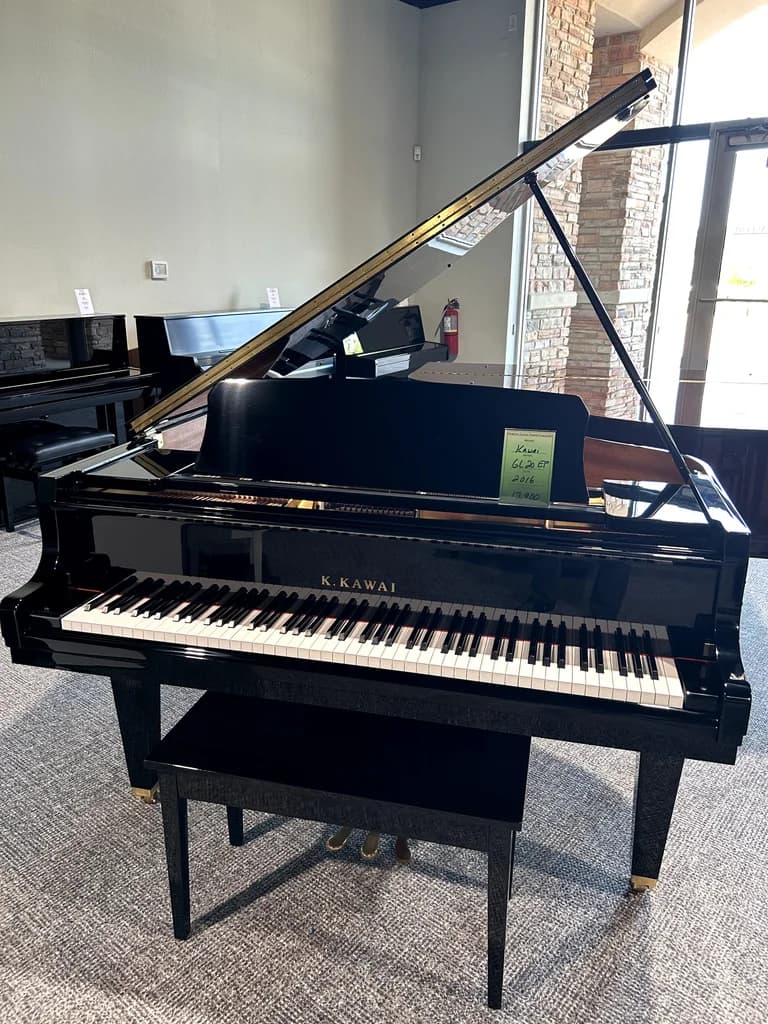
Grand Piano · Certified Pre-Owned
 $4,000 Rebate
Grand Piano · New

Grand Piano · New

Grand Piano · New

Grand Piano · New
Because the specification is constant across the line, three things decide it: the room, the repertoire, and whether the piano has to be able to go quiet.
01
A grand wants clearance for its tail, a lid that can open without hitting anything, and a room whose floor and ceiling are not both hard. The smallest GL exists precisely so that a grand can go where people assume only an upright will. Bring your room’s dimensions with you — our grand piano size guide sets out what each length needs — and we will rule models in or out before you get attached to one.
02
What grows as a GL gets longer is the bass. Longer strings give a bottom octave that is rounder and slower to fade, not simply louder. If your playing lives in the middle of the keyboard — lessons, hymns, early classical — the smaller models give up very little. If you play Chopin, Debussy or jazz with a walking bass, the larger ones will keep rewarding you for years.
03
Kawai offers ATX and AURES versions of several GL models: the acoustic piano is untouched, but it can be muted and played through headphones. In a household where practice happens at ten at night, that capability is worth more than another few inches of string, and it usually costs less than the next model up. The table above lists whichever versions are on our floor.
04
The most useful twenty minutes you can spend here is playing a GL against a GX of similar length. Sometimes the GX is obviously worth the difference. Often it is not, and people buy the GL and put the rest into a better bench, a room humidity system and ten years of tuning. We would much rather you made that call with your hands than from a specification sheet.
Kawai GL series
Length, and what length does to the bass. Both carry the same action, the same soundboard material and the same build; the GL-30 is the longer instrument, so its bass strings are longer and its bottom octave is rounder and slower to fade. In a normal living room the GL-20 is very often the more sensible piano, and in a large or high-ceilinged room the GL-30 comes into its own. The comparison table on this page shows the current size and price of each.
It is the most common first grand we sell. It carries Kawai’s Millennium III action, so a student is not learning on a compromised mechanism, and a new Kawai grand comes with a ten-year transferable factory warranty. Transferable matters more than it sounds: it survives a resale, which is a large part of why these instruments hold their value. The smaller models also fit rooms most people assume can only take an upright.
The GL grands in our showroom run from $17,395 to $42,895 today. Where a model shows a range, it is offered in more than one finish and the lower figure is polished ebony. Those are the prices you pay — delivery and the first tuning after the piano settles are included, and we do not quote on request.
No. A grand and an upright hold their tuning on the same terms — what pulls a piano out of tune is a change in humidity, not the shape of its case. North Texas swings hard between a wet spring and a dry, heated winter, and that cycle is the real reason instruments drift here. Two tunings a year is normal for a piano in regular use, and a room humidity system does more for stability than anything else you can buy.
At our Colleyville showroom, where the GL models we hold stand together rather than scattered through the room. That matters more than it sounds: any piano sounds good on its own, and the only way to hear what an extra foot of string is doing is to move between two instruments in the same room within the same minute. We are about fifteen minutes from Southlake, Grapevine and Keller.
The difference between one GL and the next is a foot of string, and a foot of string is not something you can read about. They stand together in Colleyville, fifteen minutes from Southlake and Grapevine.