
 $1,200 Rebate
Upright Piano · New
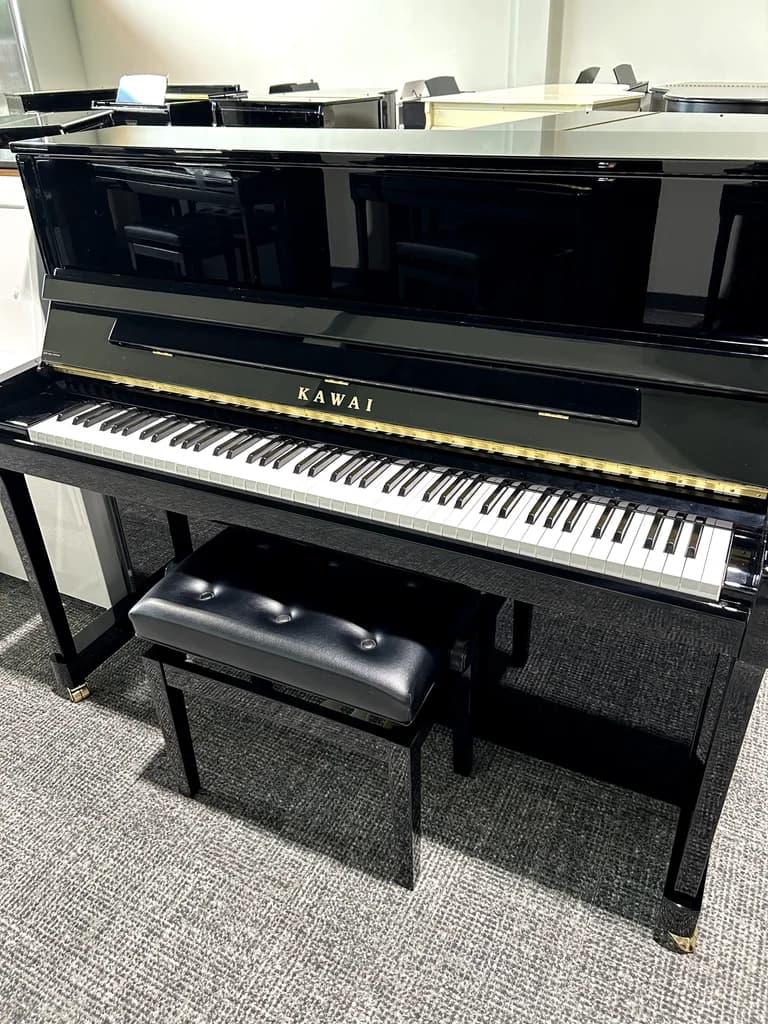
Kawai K-15 Continental Upright Piano
$6,095 – $6,69543.3"
9 K series uprights in our Colleyville showroom, ready to play.
Every model in the K line carries the same action Kawai fits to its grands. What changes as you move up the range is the cabinet height — and height is what sets the string length, the soundboard and the bass.
The K line
The K series is Kawai’s professional upright line, and it is the range piano teachers around here point students toward more than any other. Every model in it uses the Millennium III action — the same composite action Kawai puts in its grands — which is the single most important thing to know about the series. You are not buying a simplified mechanism because you bought a vertical piano.
That matters particularly in North Texas. Millennium III action parts are ABS-Carbon composite rather than wood, and wood swells and shrinks with humidity. We go from a damp spring to a dry, heated winter every single year, and wooden actions drift out of regulation on that cycle. The composite does not move with it, so a K series upright holds its touch in this climate considerably longer than the price alone would suggest.
The line is graded by cabinet height, which is the honest measure of an upright: a taller case takes longer strings and a larger soundboard. If you have not settled on an upright at all yet, our upright pianos page carries every vertical piano on the floor from every maker. This page is for the reader who has decided on Kawai and now has to choose between a K-300 and a K-400, or between a K-500 and a K-600.
Side by side
The whole line in one table, at the prices we are charging today. This is the comparison the manufacturer pages and the national retailers do not print.
| Model | Height | Price | What sets it apart |
|---|---|---|---|
| K-15 | 43.3" (110 cm) | $6,095 – $6,695 | Continental cabinet — no front legs, so it sits flat to a wall in a small room. |
| K-200 | 45" (114 cm) | $7,995 – $9,295 | The smallest K with the full professional action. A first serious upright. |
| K-300Off the floor | — | Sold | The one teachers name. The volume seller of the line, and the line’s reference point. |
| K-300 | 48" (122 cm) | $11,295 – $12,495 | The one teachers name. The volume seller of the line, and the line’s reference point. |
| K-400 | 48" (122 cm) | $12,495 – $14,295 | The K-300 footprint with an upgraded cabinet — more piano without more floor. |
| K-500 | — | $10,900 | A taller case and longer strings. The first K with genuinely grand-like bass. |
| K-500 | 51" (130 cm) | $15,995 – $17,695 | A taller case and longer strings. The first K with genuinely grand-like bass. |
| K-600 | 52" (132 cm) | $21,295 | Recital-grade upright, for a practice room that happens to be at home. |
| K-700 | 52" (132 cm) | $17,495 – $19,135 | Near the top of the line, with the build to match a serious daily player. |
| K-800 | 53" (134 cm) | $24,795 – $27,395 | The flagship. The closest the upright line gets to a grand. |
Each links through to its own page, with the full gallery, the complete specification and every finish it can be ordered in.
$1,200 RebateUpright Piano · New
 $2,100 Rebate
Upright Piano · New
Upright Piano · Certified Pre-Owned
 $2,200 Rebate
Upright Piano · New
 $2,600 Rebate
Upright Piano · New

Upright Piano · Certified Pre-Owned
 $3,200 Rebate
Upright Piano · New
Upright Piano · New
Upright Piano · New

Upright Piano · New
Also from Kawai
These sit beside the K series rather than inside it, because they are not graded against each other the way a K-300 is against a K-400. They are built for schools and practice rooms, which means heavier hardware and finishes chosen to survive being knocked about by a hundred different people. That makes them unusually hard-wearing in a home, and they are worth asking about if the piano is going somewhere it will take punishment.
| Model | Height | Price | What sets it apart |
|---|---|---|---|
| ST-1 | 46" (117.5 cm) | $8,295 | Durable studio upright with Millennium III action and four finish options for institutional use |
| 506N | 44.5" (113 cm) | $5,495 | Durable institutional upright with reinforced construction for schools and studios |
| 506NOff the floor | — | Sold | Ebony Satin |
| 508 | 48" (122 cm) | $6,495 | Heavy-duty institutional piano built for high-use environments with exceptional durability |
Four things decide it, and only one of them is the price.
01
Everything that changes between one K and the next follows from the cabinet height: string length, soundboard area, and how much real bass register the piano has. A taller K is not so much a louder piano as a deeper one. If the room is small and hard-surfaced, the shorter models are often the better musical choice as well as the cheaper one — a big upright in a tiled room is not a kindness to anybody.
02
A student who will play for a few years and a student heading toward auditions need different instruments, and the gap across this line is real. The smaller models are genuinely good pianos and exactly the wrong ones to buy for someone who will outgrow them in three years. The larger ones are wasted on a household where nobody practises. We would rather ask the question than sell you the wrong end of the range.
03
Several K models are built in AURES and ATX versions: the same acoustic upright, with the ability to stop the hammers short of the strings and play through headphones. In a house with shared walls, small children or a practice schedule that runs late, that capability changes how much the piano actually gets played — which matters more than any specification. The table above lists whichever versions are on the floor today.
04
Nobody can hear the difference between two uprights from memory. The K models we hold stand together, so you can play the one below your budget, the one at it and the one above it inside ten minutes and find out whether the step up is audible to you. If it is not, buy the cheaper piano — and put the difference toward keeping it stable in this climate.
Kawai K series
They stand at the same height, so string length and soundboard area are comparable and the two sound closer to each other than either does to a K-500. The K-400 is the upgraded cabinet and specification of the pair, including a grand-style music desk. If your constraint is the room rather than the budget, the K-400 is how you spend more without taking up more floor. The comparison table on this page shows both at today’s prices.
In this area, the K-300 more often than anything else. It has been in Kawai’s catalogue a long time, it is the volume seller of the line worldwide, and it sits at the point where a student stops being held back by the instrument. That is not a reason to buy it without playing the models on either side of it, but if you asked us to name one upright for a serious beginner, it would be that one.
The upper models are, and plenty of conservatory students practise on them daily. The limit of any upright is not the action — the Millennium III is the same mechanism Kawai fits to its grands — it is that the strings run vertically and are shorter, so the bass has less to work with and repetition at real speed is not quite a grand’s. For hours of practice in a home, the top of the K line is closer to a grand than most people expect.
The K series uprights on our floor run from $6,095 to $24,795. Where a model shows a range it is offered in more than one finish, and the lower figure is polished ebony. Those are the prices you pay: delivery and the first tuning once the piano has settled are included, and we do not quote on request.
Yes, and we do it ourselves rather than handing it to a freight company — an upright is heavy, awkward on stairs and easy to damage in the wrong hands. Delivery and the first tuning after the piano has settled are included in the prices on this page. We cover the whole metroplex from Colleyville, and if the instrument is going upstairs or through a tight turn, tell us beforehand so we can plan the route rather than improvise on the day.
The K series is graded finely enough that reading about it will not settle anything. They stand together in Colleyville — fifteen minutes from Southlake and Keller, half an hour from Fort Worth.